
2026
A Tale of Three Aleutian Volcanoes: Okmok, Westdahl, and Veniaminof
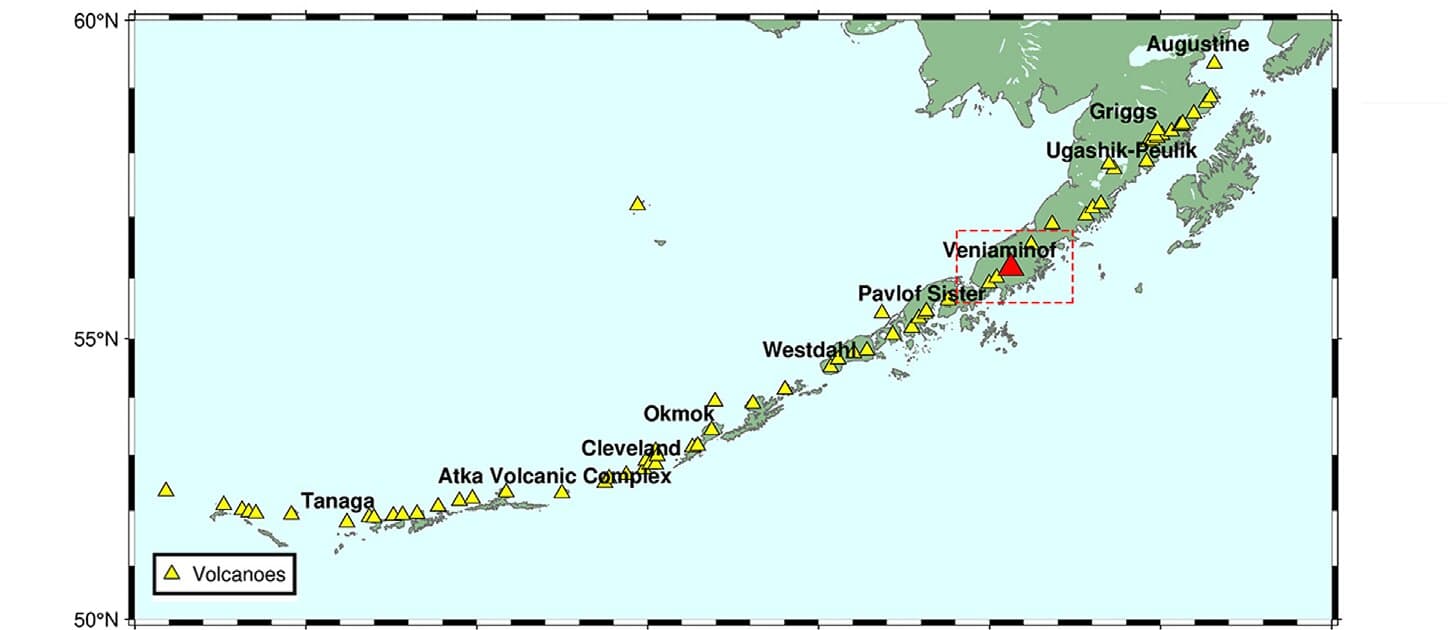
Three Alaskan volcanoes with similar settings behave very differently: Okmok's large 2008 eruption came with only brief warning, Westdahl has swelled for decades without erupting, and Veniaminof erupts often with almost no warning. This study models all three in one framework to explain why.
The question
Volcanoes that look alike on paper can behave very differently in the lead-up to an eruption. Okmok, Westdahl, and Veniaminof share similar tectonic settings and magma compositions, yet one gave only a short seismic warning before a significant eruption, one shows prolonged unrest with no eruption, and one erupts with little detectable warning. What controls these different behaviors?
What I did
I modeled each volcano within a common three-dimensional finite-element framework that includes realistic topography and is constrained by ground-deformation data, following each system from its most recent eruption through the years of repose that followed.
What we found
Each volcano follows its own physical pathway. Okmok can move toward eruption rapidly, leaving a compressed warning window; Westdahl accumulates magma for decades with limited rock failure and no eruption; and Veniaminof's smaller, rapidly cycling system can erupt with little detectable warning. The differences come from properties such as reservoir depth and shape, the rate of magma supply relative to the reservoir's size, and the weight of overlying ice.
Why it matters
Warning signs cannot be read with a single universal threshold. Interpreting unrest requires understanding the physical state of each magma system, which argues for monitoring strategies that combine models with real-world data. The manuscript is currently under review at Geophysical Research Letters.
Related Outputs
Links will be added once the paper is published.