
2026
Inflation Without Eruption: Three Decades of Unrest at Westdahl Volcano
Westdahl Volcano has been slowly swelling for more than 30 years since its 1991–1992 eruption, yet it has not erupted again. This project uses 3D computer models checked against GPS and satellite data to explain why, and to ask how close it may be to erupting.
The question
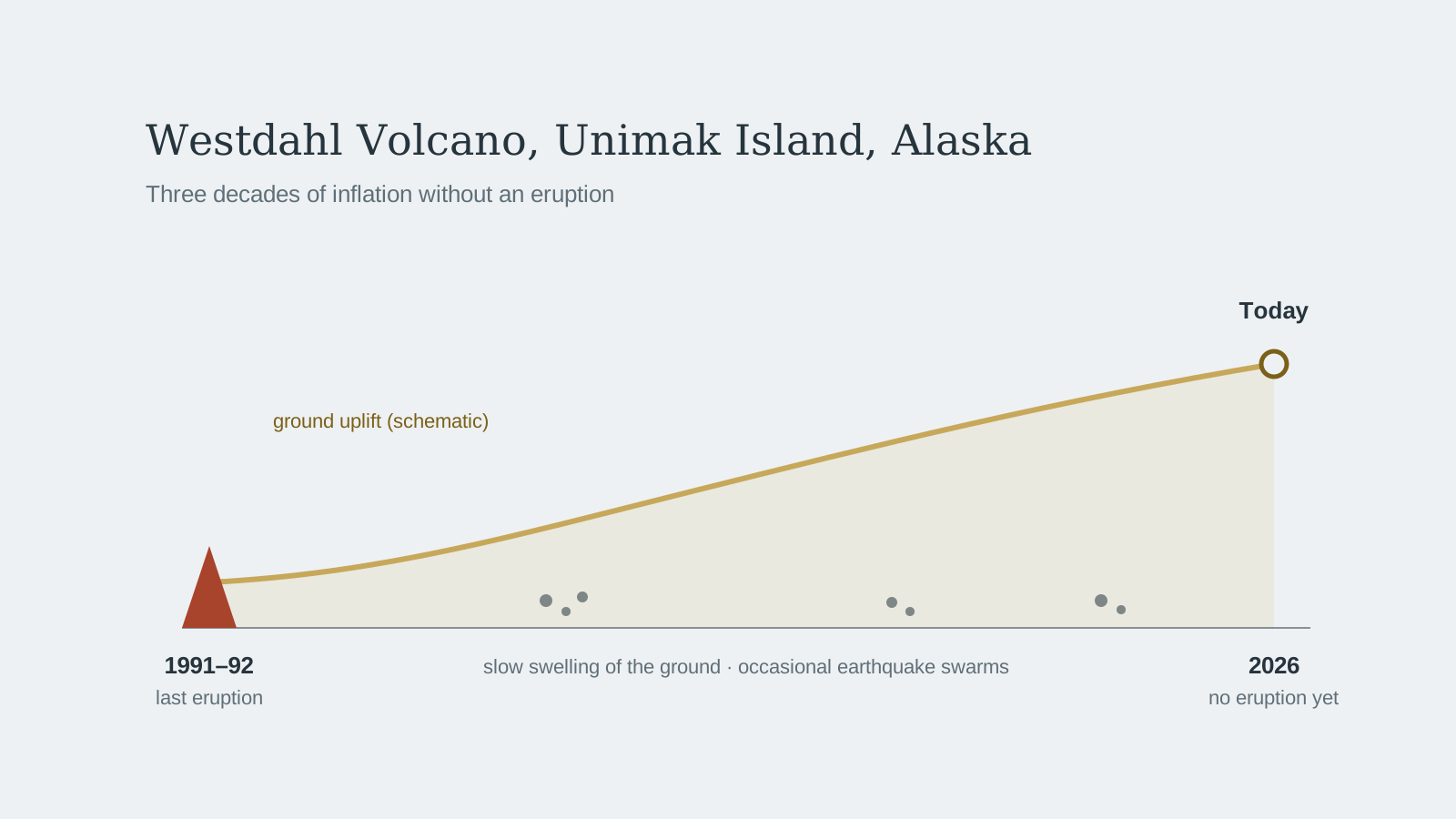
Westdahl, on Unimak Island in the Aleutian arc, has inflated for decades since its last eruption in 1991–1992, with occasional swarms of earthquakes. Many volcanoes around the world show similar long-lived swelling without erupting, which makes it hard to know when, or whether, an eruption will follow.
What I did
I built three-dimensional thermo-mechanical finite-element models of the Westdahl magma system that include the real shape of the volcano, the weight of its glacial ice, and rock whose behavior depends on temperature. The models are checked against decades of GPS and InSAR ground-deformation records and used to track how stress in the surrounding rock has evolved since the last eruption. A data-assimilation framework (see the EnKF project) complements the models by updating them with observations.
What we found
Several factors work together to hold back an eruption: a deep reservoir and the overlying ice increase the pressure that confines the magma, the thermal state of the crust buffers how the surrounding rock responds, and repeated intrusions may stiffen the rock and seal fractures so that magma is stored rather than erupted. Even so, the current stress state suggests that Westdahl has entered a window in which an eruption is mechanically plausible.
Why it matters
Westdahl represents a whole class of persistently inflating volcanoes. The framework offers a way to evaluate eruption potential at similar systems worldwide and makes Westdahl a system of particular interest for continued monitoring. A manuscript is in preparation for JGR: Solid Earth, and the work will be presented at the AGU Annual Meeting in December 2026.
Related Outputs
Links will be added once the paper is published.