
2026
Tracking a Volcano's Hidden State with Data Assimilation
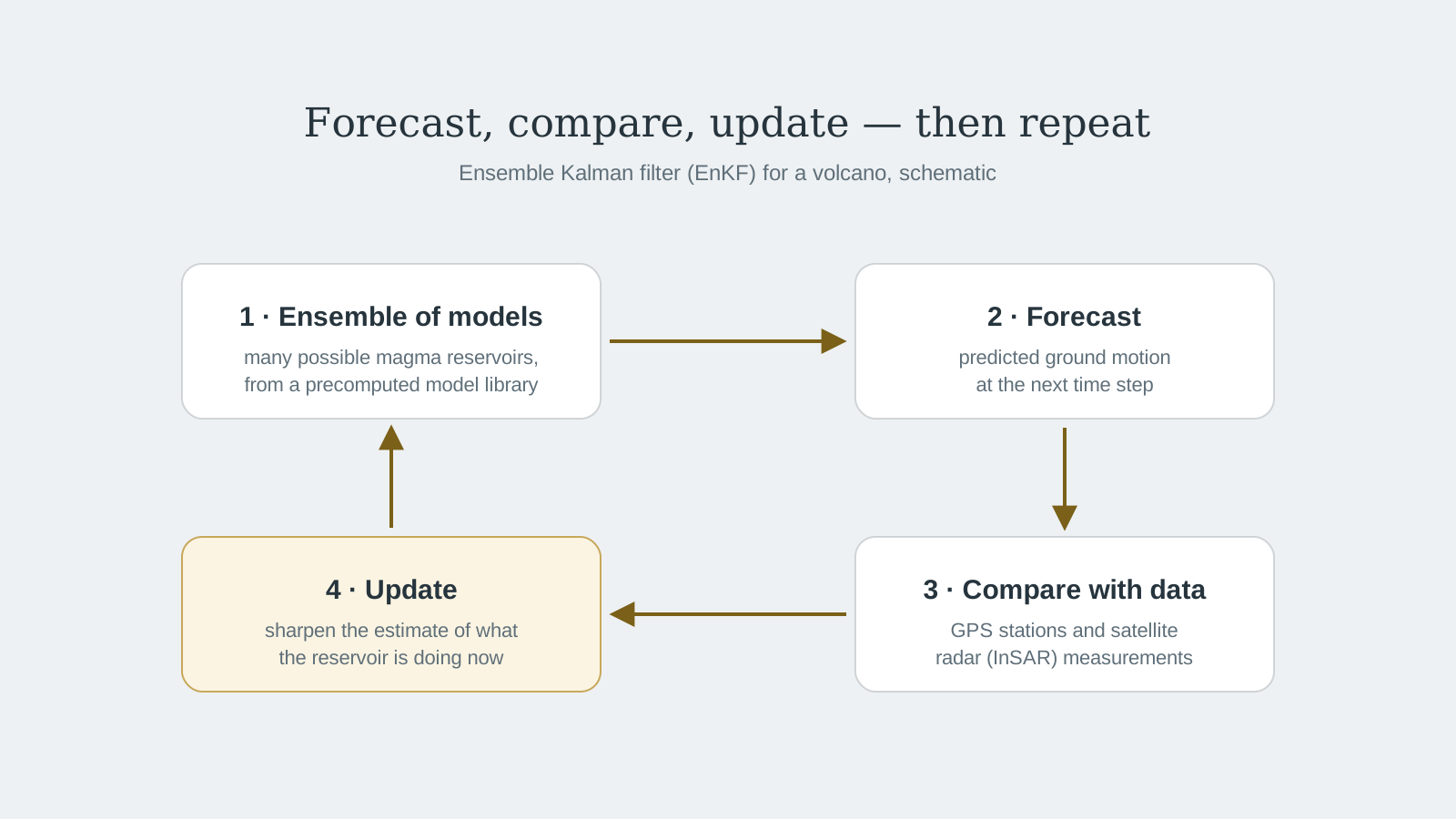
Weather forecasts improve by continuously blending new observations into models. This project applies the same idea, an ensemble Kalman filter (EnKF), to volcanoes, updating physics-based models of Westdahl's magma reservoir with GPS and satellite radar data.
The question
Monitoring data show that the ground is moving, but not directly what is happening in the magma reservoir below. Which properties of a reservoir can the observations actually pin down, and which depend on the assumptions built into a model?
What I did
I implemented a sequential ensemble Kalman filter that assimilates GPS-only, InSAR-only, and combined GPS and InSAR data at Westdahl. To make it fast, the expensive finite-element simulations are computed once and stored as a library of precomputed responses; each update draws on this library instead of rerunning the full model, which makes it practical to run hundreds of physics-based assimilation experiments.
How it is tested
Synthetic tests, hold-out tests, and repeated runs with different random seeds are used to check which reservoir properties are truly constrained by the data, whether GPS and InSAR tell a consistent story, and how sensitive the answers are to modeling choices.
Why it matters
A forecasting system that updates as new data arrive can track whether a volcano is moving toward or away from conditions that favor eruption, while being clear about what the data can and cannot tell us.
Related Outputs
Links will be added once the paper is published.