
2026
Deep Earthquakes and Rising Volatiles Beneath the Alaska-Aleutian Arc
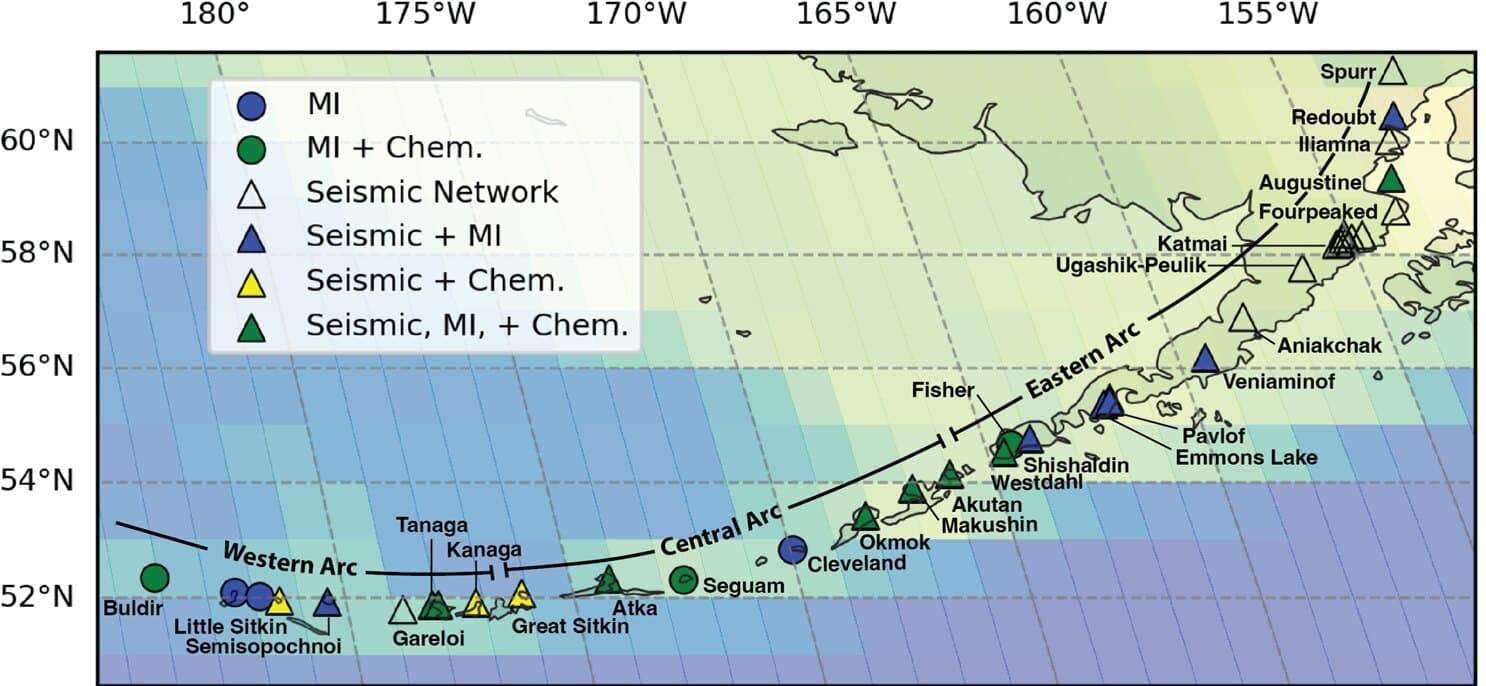
Deep long-period earthquakes here occur 10–55 km below sea level, far deeper than the shallow magma reservoirs that typically feed eruptions. Combining 34 years of earthquake records from 22 Alaskan volcanoes with geochemical data, this collaborative study links them to volatiles, mainly CO₂, escaping from magma.
The question
Deep long-period (DLP) earthquakes are low-frequency events that occur deep beneath volcanoes during quiet periods, unrest, and eruptions. What generates them has long been debated, and they may reveal how magma and fluids travel through the crust.
What we did
Through the CIDER summer program at UC Berkeley (2023) and an ongoing multi-institution collaboration, our team combined the Alaska Volcano Observatory earthquake catalog (1989–2023) with independent constraints on where magma is stored and where gases come out of solution at 22 volcanoes. I contributed major geophysical components of the study, including DLP depth distributions, their timing relative to eruptions, and variations along the arc, and helped formulate and test its central hypothesis.
What we found
DLP earthquakes cluster at 10–25 km and near 32 km depth, matching where magma begins to crystallize and where volatiles first come out of solution near the base of the crust. The results suggest that DLPs near the base of the crust (about 32 km) are driven by gas coming out of solution as magma rises, and shallower crustal DLPs by gas released when stalled magma crystallizes.
Why it matters
Linking deep seismicity to volatile release offers a new way to read how 'open' a volcano's deep plumbing system is, using signals that monitoring networks already record.